Wednesday, October 17, 2012

Deshpande Foundation -Invites Application for Deshpande Fellowship Program

Warm regards from Deshpande fellowship program (DFP)

We are pleased to inform you that the Deshpande Fellowship Program is now receiving applications for tenth batch. Deshpande fellowship program was begun in order to empower a major untapped resource in the development field: hungry young people with plenty of potential to go for in their field who are held back only by their skills and self- confidence. DFP seeks change that and help participate to realize the true potential and ambitions.

This rigorous 7½ month residential leadership development program,Through NGOs visits, village studies, entrepreneurial and Leadership activities and intensive course work, fellows gain skills needed to become true leaders in their chosen field.  

With a concentration on social entrepreneurship and innovation, the DFP has transformed over 200 fellows into entrepreneurial young leaders. Kindly spread the words with your colleagues, friends and who interested to become part of the Fellowship Program. 

Interested one apply directly by using attached application or can be downloaded from online-http://www.dfp.org.in/. 

For more information you can reach us at fellowship@dfmail.org or               9740011883      and read the attached files.

We look forward to hear from you soon.

Note: Last date for application will be 28.11.2012, Hurry to apply!

Wednesday, July 11, 2012

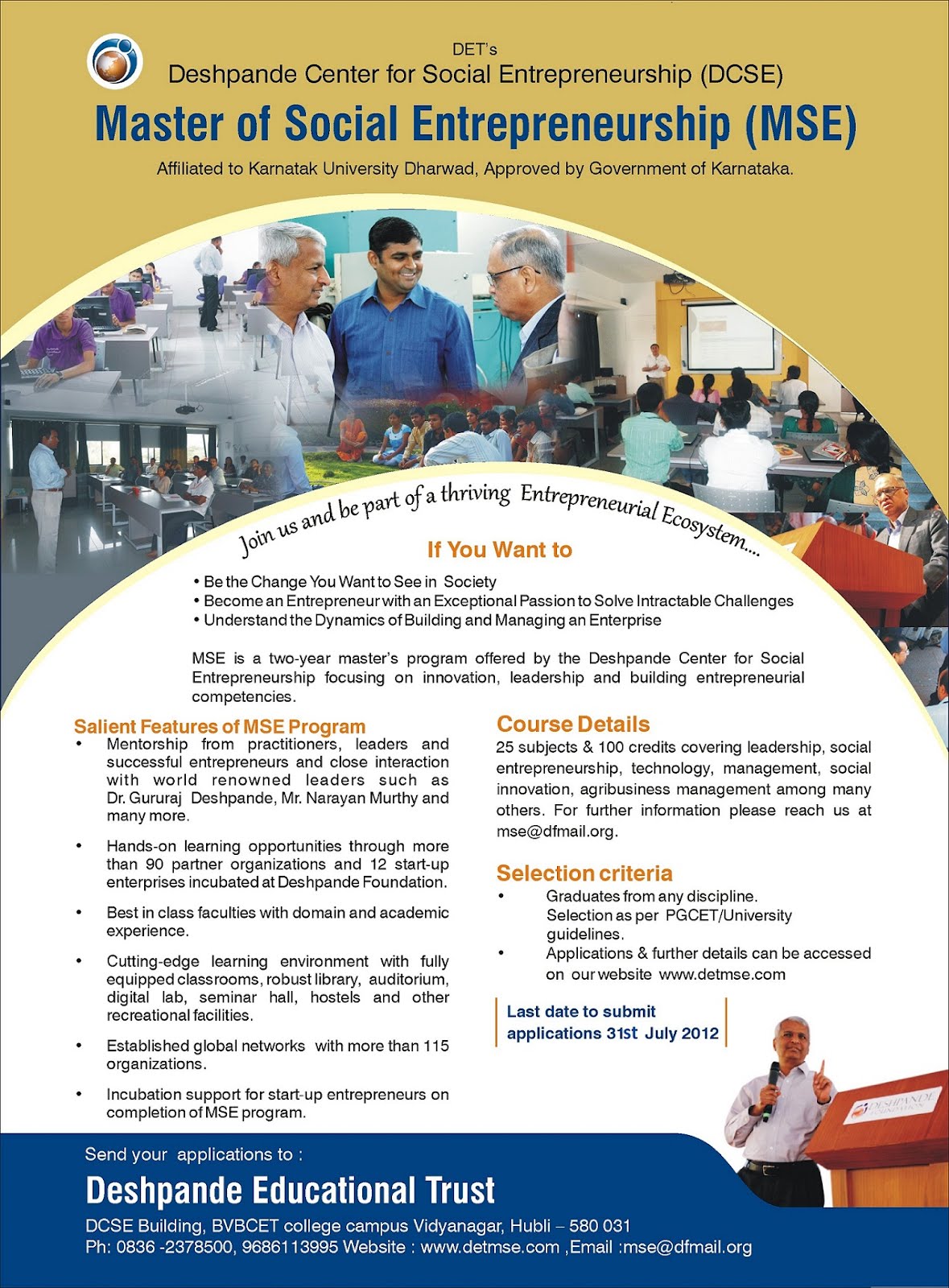
Master of Social Entrepreneurship program- in Hubli-INDIA

Master of Social Entrepreneurship program launched by Deshpande Education Trust’s Deshpande Center for Social Entrepreneurship, Hubli, India
The Deshpande Education Trust (DET) announces the launch of its Master of Social Entrepreneurship program. The Master of Social Entrepreneurship (MSE) is a two-year residential program affiliated with Karnatak University Dharwad and approved by the Government of Karnataka. MSE offers students essential skills in social innovation, entrepreneurship, leadership development and business practice taught by scholars and practitioners who actively engage in leading enterprises and promoting entrepreneurship. Applications for the program are due July 30th 2012 and courses will begin August 22nd 2012. For more information on the program and admissions process: www.detmse.com What makes MSE program special? With an aim to demystify social entrepreneurship for young and creative minds this residential program is carefully designed from a practitioner’s perspective. MSE is hosted by Deshpande Center for Social entrepreneurship (DCSE) that has been a breeding ground of several start-ups, an international network of enterprises and concrete partnerships with over 100 for profits and not –for profits who all are engaged in solving social issues with a compassionate heart and entrepreneurial mind set. Two year program is packaged with 25 different courses that blend with cutting edge practical experience as well as personal mentorship through real entrepreneurs. Our international experience in US and Canada where Deshpande centers have been launched in renowned universities with a sole objective to make “learning relevant and responsive to real time challenges” and embark on an even more ambitious aim to help students not just ‘learn’ about entrepreneurship but find the inspirations and tools of becoming an entrepreneur themselves. Learn more about our international work at http://www.detmse.com/network.html Faculty Profile: One of the distinguishing factors of the Deshpande Center for Social Entrepreneurship is its faculty and resource personals. DCSE is gifted with passionate faculty with substantial experience in the social enterprise and related sectors at a global level. For more information http://www.detmse.com/trainer.html Who should join MSE? Graduates in any field who are looking to step into creating or managing a social enterprise themselves. People who are passionate about social issues but still possess an entrepreneurial acumen to venture into innovative and yet sustainable initiatives. We are pleased to share that being located DCSE MSE program brings an added advantage of possibility of getting incubated in our Entrepreneur in Residence program, an incubation centre where several other start-ups will accompany you as you chart the journey of developing a small idea into a big impact. Through our established network of organizations, placement support will be provided to students in both for profit and social enterprises. How to apply? Application can be downloaded at our website. For complete details please visit www.detmse.com . Seats are limited and deadline for us to receive application is 31st July 2012.

Friday, December 4, 2009

AFTER FELOWSHIP

Hi viewers,

After long time I am posting...........

Relay I had and spend wonderful time in "DESHPANDE FELLOWSHIP" program and learn t and experimented lot many things
Some of the important work I did and learn t........

- Nature of social entrepreneurship VS NGO concept
- How to use tech(IT) in working place or in our own social venture
- Managerial Communication
- How to deal with RURAL INDIA
- Identifying problem with solution
- How to build Global and local Connections
- Event Management
- Fund raising for cause
- Project preparation, Accounting and financial management
- Entrepreneurial activities
- Revenue model identification
- Business plan preparation (I and my team build BP for Career Guidance Center)
- Marketing
- Monitoring and Evaluation
- Hints about all the sectors like Health, Education, Agriculture, livelihood etc


still several modules I learn t during the program these all are important ones
after fellowship what happened to me......... wait and see

Monday, June 29, 2009

Creativity in IT !!! IT!!!


Hi blog viewers such a long after I am writing blog for you on sparking event,

Are you ready to read this,

Do you think blog writing is an event or media writing ?

No Never its not exactly writing an event as you write a note..................... ok have look below!!!


On 29th Jun 2009 morning class engaged by Mr. Badrinath about IT. This class whole about creativity in blogging how to put the 'individual first conception about event or activity in to world or picture' the main concept behind this is because of any distraction 'don't miss or live your creativity. In the same way how to visualize the idea.

Process starts like this,

* Draw the pictures of words
like I am God etc
*Question-Answering - Relating both

*Story completion

Through All the activity he made us to go on, go on deeper in to our own thought process about the thing.


Tuesday, May 5, 2009

Eco-Tourism

Part of our course in Deshpande foundation we had visited DANDELI forest for 4 days and enjoyed with nature mingle with tribal people. we all fellows had food with them,exchange cultural with them, discuss about in what extent can we help them to get livelihood,played a drama about natural resource utilization, Game play for children's,tracking,wildlife safari,visit to KAVALA cave and so many activity with this.
this module really one of the most enjoyable module for me and also we had a session on bird watching also
one more happiest movement was that our Eco tourism instructor's were my Senior fellows they have organized programme very well manner. Picture with nature

Wednesday, March 11, 2009

Street Play

21 IN A DAY: Where there is a will there is a way.
We all Deshpande Foundation Fellows celebrated International Women's Day on 8 March with new initiative.
The main objective of this one day campaign was to encourage women to ask for their rights, sensitization of men and boys to stop discrimination and violence against women and give equal respect to all women and girls and secure equal participation of women.


All fellows conducted 21 street play activities in different communities, villages, public places around Hubli-Dharwad District of Karnataka. In these programmes along with 18 fellows a mass of local
people participated. facilitated and coordinate all fellows in conducting activities and other related works. Till the end of the day fellows conducted activities in 21 places of Hubli-Dharwad like: Gantikeri, CBT, Anand nagar, Nekarnagar, Old Hubli, Devinagar, Chetana colony, Railway quarters, Unkal, Bhairidevarkoppa, Navanagar,Gamanagatti of Hubli and Navalur, Sattur, Gandhinagar, Ambedkar Colony, Jannatnagar, Tejashwininagar, Laxmi singanakere, Nehru nagar and Srinagar of Dharwad area. By visiting these places and conducting street plays message was passed to more than 5000 people.

Guest Lectures:

Friday, February 20, 2009 : Guest Speaker
On 20th February Mr. Ayyappa M.Masagi oriented us about his great work of water saving, harvesting and knowing the value of water and water resource.. His vision is to make water efficient Globe. Thousands of experiments have been done for rain water harvesting by Masagi. He has been awarded for this work as an Ashoka Fellow and many other national level awards. This journey was started in 1994 by researching rain Water harvesting methods in his own farms lands. In 2005 he started WLF Water literacy Foundation to make Nation water efficient. ‘Harnessing our
most precious resource (water) and bringing it to the people’ is the motto of WLF. He also stated that Earth has 25% land and 75% water, out of it only 2.53 % is fresh water. Out of 2.53% of fresh water 0.3% lakes and 30% is in ground. Main techniques those are being used for saving water are Recharge, safe, reuse and use efficiently. Related to water conservation he conducted more than 1200 programs in 8 states of the nation. Masagi believes in simple living and high thinking.


Guest Speaker Mr. Vivek Pawar
On 27th of February in my Deshpande Fellowship Program I attended an interactive session with Mr. Vivek Pawar, founder of Sankalp Semiconductors. Sankalp is one of the leading companies that design and manufacture chips and conductors for television, cell phone, digital camera, sound systems etc. Vivek formed this entreprise in 2005 in Bangalore and soon after one year it got settled up in Hubli at BVB Engineering College campus and became India’s first MNC that has its office in a college campus.He explained his life journey from schooling to M.Tech in electronics. He was an average student and not more
serious about good marks always. He did schooling from a boarding school and engineering with electronics from Pune. His more interest was on television and it’s functioning. So he got campus placement in a television company late he joined Videocon. He soon got promotion as assistant production manager and did a record production of manufacturing TVs. He increased the production from 20 TV per month to 400 per month. But did not continue his job there he left his handsome job and joined M Tech for further study, there in a campus selection he got an offer in Texas Instruments (One of the best company in chip making) and placed in United States of America. His will power always pushes him towards success. On the bases of his will power he was cured himself after reaching up to third stage of cancer.
all DFP cohort 2 fellows with Mr. Vivek PawarDuring this session he gave many learning like; ‘Focus on the particular way where you can perform better and put all energy there in centralized way’. He told about ORIA (Observeà Reflectà IntrospectàApply/Action) that how to react on a goal to achieve that.
Meet with Mr. Paresh Choudhari Reliance in DCSE:


During his speech he appreciated social entrepreneurs. Around 100 audiences were presented in this moment.
Wednesday, March 11, 2009 :Dr. J.K.Hiremath, founder of 'Manovikasa' started this organization in 1994 for special children (rehabilitation center for mentally retarded children). His daughter is the inspiration for starting this special school. She suffered from meningitis and died in the year 1994. This incident made him to run this school for special children. Dr. Hiremath visited Deshpande Foundation on 6 March as Guest Speaker and spent his valuable time with all DFP Cohort II fellows. He shared all about Manovikasa and his efforts.
Dr. Hiremath was working in an American organization resigned his job came to India & in 1994 he started a small day care center with two rooms from 10:30am to 4:30pm for mentally retarded children. This grew into a residential school by 2003.
Reasons for the development of mental retarded
Age of the mother
Mental & physical health of the mother & Genetic abnormalities
Mother’s addiction to drugs

Malnutrition
Half attempted abortion
Use of un prescribed drugs
Accidents & Epileptic attack by hormonal change
Forceps delivery (80%)
Alexia
Prolong delivery
Cesarean (2%) & Low birth
Functions of Manovikas
Being a neuro clinical psychiatrist Dr.Hiremath design the perfect residential arrangement for the mentally challenged children. He could also successfully design the activities of Manovikas. They are,
· Visiting the villages & building the awareness.This includes early identification, facilities available from the government, diagnosis & issue of certification.
· Convergence service. They have adopted 7 districts in Kanpur, each village is having some SHGs which helps in the taking care of the children, for this parents of the children are charged Rs2/-
· Upanayana. Here they train the parents as co-therapists. Different therapies will be given to the child. Like,
Hydro therapy
Sand therapy
Jump fit therapy
Multi sensory stimulation therapy
Squint correction therapy
Physiotherapy
Vita therapy
Speech therapy & Drooling therapy
· Special education system. Here level assessment of the children is done by check list. They follow the individual rehabilitation program (IRP), in which each child will be having its own curriculum. Basic knowledge like Time, Money, Writing name, Signature was taught to the students. For female domestic ability development program is also conducted. Music therapy, sports, yoga, dance is also part of the school activities.
· Residential service. They teach self help skills like, Toilet training specially reporting, eating, bathing, grooming, for female menstrual hygiene. They also take children for excursions.
· Achievements of school.
Gold medal in china in swimming
· Challenges face.
Meet the parents expectation
Rehabilitation of children in home
· Contact:Ph.-9243281756
e-mail:manovikasa@yahoo.com.

Advocacy:

5th March 2009 :Importence of ADVOCAY.

As a part of our course module the ADVOCACY taken by 2 recourse persons namely Ms. UshaRani and Dr.Gopal Dabade, SDM Medical College. This advocacy is a people centered activity and good weapon to make public authority to work honestly. Both the class were very interesting they told their own work experience with advocacy what I understood by class.


What is the meaning of Advocacy?
To protect rights or change unfair discriminatory or insulting treatment to fair, equal, and humane treatment, To improve services, gain eligibility for services or change the amount or quality of services to better meet the needs of an individual and To remove barriers which prevent full access to full participation in community life.

10 Steps in Advocacy
· DEFINE THE PROBLEM—what is the issue? Who do you have the problem with?
· SPELL OUT THE SOLUTION—Define your goals. What do you WANT? Get a picture of VICTORY in your mind!
· DETERMINE YOUR RIGHTS—which department regulates what is going on? Locate and review the appropriate regulations and procedures. If you need assistance understanding the material, get help from someone who is informed. Ask for your rights, even if you can’t find the regulations to back you up.
· WHO WILL DETERMINE WHAT HAPPENS?—who makes the decisions?
· PREPARE YOUR CASE—Get your paperwork and documentation in order. Keep a notebook of phone conversations and correspondence. Plan a strategy. Try to separate feelings from facts.
· PLAN—Write an agenda. Practice presenting your case or problem to a friend or advocate.
· ACT—Make the phone call or write the letter. Be assertive NOT aggressive. State what you want and when you want it.
· EVALUATE YOUR RESULTS—what was the outcome? Will you need to follow-up? How do you feel about the results?
· FOLLOW-UP—Take any necessary follow-up steps. Decide what to do next.
· CELEBRATE—even small victories should be celebrated. Congratulate yourself for taking the steps to resolve your problem.

Wednesday, March 4, 2009

Right to Information Act,2005 Leads to Good Governance


- A Class by Thippanna & Ashutosh

Introduction:
Above said two instructors thought us RTI act with practical module in 3 days. I am very much happy to mention that these 2 fellows are our seniors in DCSE under DFP.
The Right to Information Act was enacted by Parliament in 2005. It is an effective weapon in the hand of public. We can call this act as base for other all acts. By hearing name of this RTI every Government organization will starts to shivering that may be Central, State government officers and who getting fund from government partially or completely it means every Indian citizen can get information from these offices 13 states are enforced this act in the year 2005(Kerala, Gujarat, Chattisgarh,Haryana,Punjab,Tripura, Andhra Pradesh, Uttaranchal, Meghalaya, West Bengal, Orissa and including Karanataka)
“Every shall have the right to freedom of expression; this right shall include freedom to seek, receive and impart information and ideas of all kinds, regardless of frontiers, either orally, in writing or in print, in the form of art, or through any media of his choice.” .
This act calling as RTI act 2005 its commenced on 12th October 2005, it apply whole India except Jammu & Kashmir, according to this every information we can get apart from information, disclosure of which would prejudicially affect the sovereignty and integrity of India, the security, strategic, scientific or economic interests of the State, relation with foreign State or lead to incitement of an offence etc this act bulk of 22 sections.


Some of the important sections:
· Section 4(1)(b) Sue-Muto (Organization self declaration with 17 points)
· 6(1) is file a application for specific information
· 18 complaint on concern person for refusal of application without providing proper information

“Every shall have the right to freedom of expression; this right shall include freedom to seek, receive and impart information and ideas of all kinds, regardless of frontiers, either orally, in writing or in print, in the form of art, or through any media of his choice.”


From 3 days class I come to know the following matters relating to RTI.
· Universal access to information
· Right to information includes inspection of records, works and taking certified samples of material.
· “Information” includes that records, e-mails, samples and models.
· It covers all the public authorities, NGOs, private bodies which is getting fund by government
· PIO should provide information.
· No prescribed form for information.
· Reasonable fees (only for photocopies).
· P.I.O. has the duty to assists requesters.
· No need to give reasons for requesting information.
· If Information concerns the life and liberty to be provided within 48 hours
· Information to be providing within 30 days of receipt of request.
· Public can directly make complaints and appeals to information Commission


Finally this act is very much important to access our individual rights. But about this education and awareness programme is required. It is a good platform to common man.
FORE MORE INFORMATION REFE:

www.apnait.org and www.apnait.wordpress.com